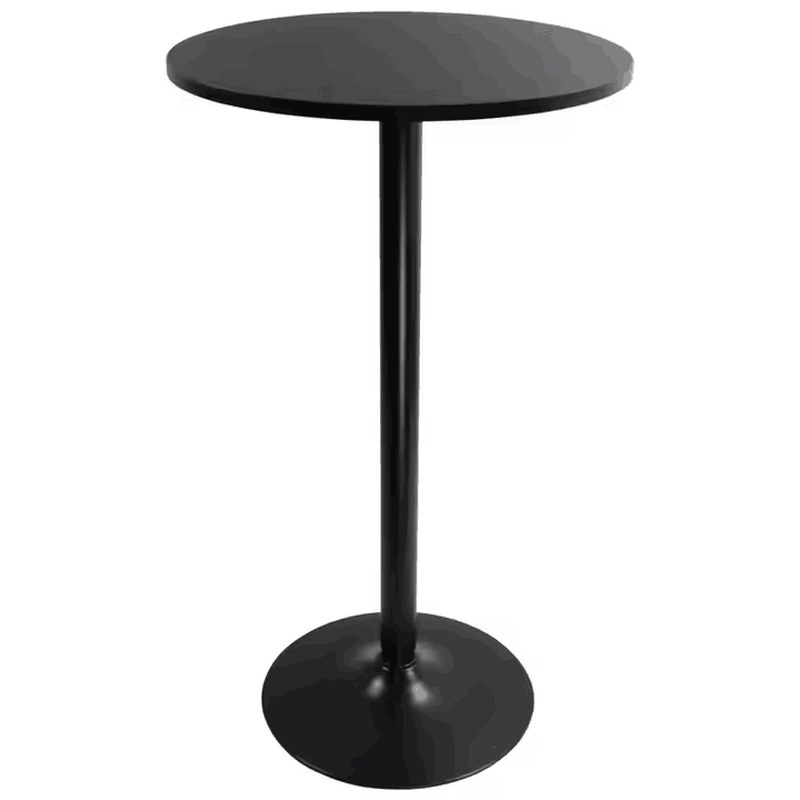
Round bar height table, Ø600 top
1054 mm of standing height under a Ø600 steel surface, carried on one column over a Ø420 cast iron disc. Sized for two people standing at it, not for a party of six.
| Top | Ø600 mm, powder-coated steel |
|---|---|
| Top thickness | 20 mm |
| Height | 1054 mm · pairs with a 750 mm stool |
| Base | Ø420 mm cast iron disc |
| Column | Single steel column, welded to the top plate |
| Colour | Any RAL, powder coated · black as standard |
| Assembly | Column bolts to the disc on site, four bolts |
| Packing | One per carton, top and base wrapped separately |
| Minimum order | On request · typically 20 pieces per colour |
| Terms | EXW Foshan or DDP to your address |
Trade enquiries only · EXW Foshan or DDP · replies inside three working days
1054 mm is a stool measurement, not a table measurement
The height is the first decision, and it belongs to the stool rather than the table. 750 mm seats need the underside of the top at roughly 1050 to 1100 mm to leave a hand's width for the knees. This one sits at 1054 mm, which is 41.5 inches rounded to the nearest millimetre — the number came off an imperial drawing before it was converted, and it lands inside the working range.
What that means in the room: two people stand at the top with their drinks on it, and neither of them has to lean down. Anything lower turns a standing zone into a perching zone, and a guest who perches leaves after one drink.
One column, and somewhere to put both feet
Four-legged tables at standing height put a leg exactly where a person wants to stand. Three feet is the minimum for a stable top, and at 1054 mm every one of them is at shin level. The single column clears the whole circumference, so the table can be used from any side — which is the point of a table standing free in a room instead of against a wall.
The column is welded to a plate under the top rather than bolted through it, so the fixing never shows on the surface and the top cannot work loose from the underside.
The disc is what keeps it where it was put
Standing-height tables take a different kind of load from dining tables. Nobody sits at them — people lean, rest an elbow, put a foot up. That load arrives off-centre, every time, and a light base walks across the floor by the end of an evening.
The base here is a cast iron disc at Ø420 mm, which sits inside the Ø600 top footprint. It is narrower than the top, so nobody catches a toe on it when they walk past, and the mass is low where it does the most work.
What a Ø600 top holds
Two people, two glasses and a plate between them, and nothing else. That is not a limitation to design around; it is what keeps a standing zone moving. Rooms that put 800 mm tops in standing areas end up with people sitting on them, which is the one thing a poseur area is meant to prevent.
If the zone is meant for four people standing and eating, two of these side by side read better than one larger top, because the gap between them gives the group somewhere to stand.
Colour
Black is standard and most of these go out black, because black disappears against a dark floor and lets the room carry the colour. Any RAL is available on the powder coat, on the top, the column and the disc together — a two-tone table is possible but rarely wanted once you see it.
The coating is a single colour over the whole piece. There is no separate finish on the base, so the item does not read as two parts bolted together.
Assembly, packing and terms
The column bolts to the disc on site with four bolts, and the top arrives already fixed to the column. Two hands and a spanner do a room of them in an afternoon, and the discs stay flat in their cartons until the moment they are needed.
Top and base ship wrapped separately in the same carton, because a disc loose against a coated top in transit is how a table arrives with a chip in the edge. Minimum order is quoted per colour; EXW Foshan or DDP to your address.
What to send
How many, what colour, and where the room is going. If the standing zone already has a stool height fixed, send that number instead of the table height — the two are decided together and one of them is usually already locked by the bar counter next to it.
How it sits in a bar
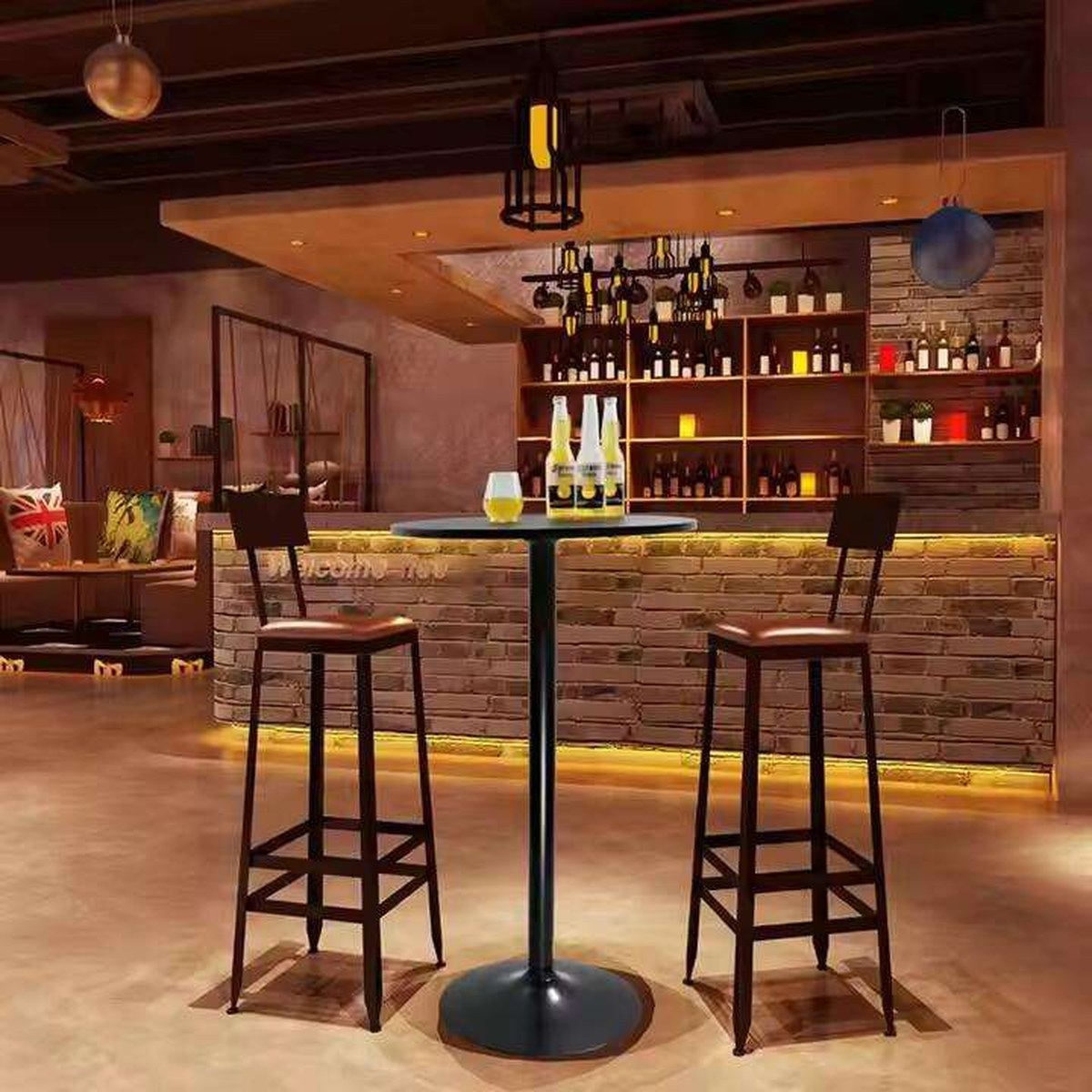
At 1054 mm the top sits between the seating and the back bar, close enough that a glass goes down and comes back up without the guest turning round. That is the whole job of a standing zone: it holds people who are not ready to sit down yet, and it does it in half the floor space of a table and chairs.
Photographed in a working bar. Reference image, not one of our own installations.
Next in the same range
Send a floor plan, get a priced layout back
Tell us the counter length, the number of covers and the look you want. We come back with stool counts, heights, finishes and a written quotation — usually inside three working days.