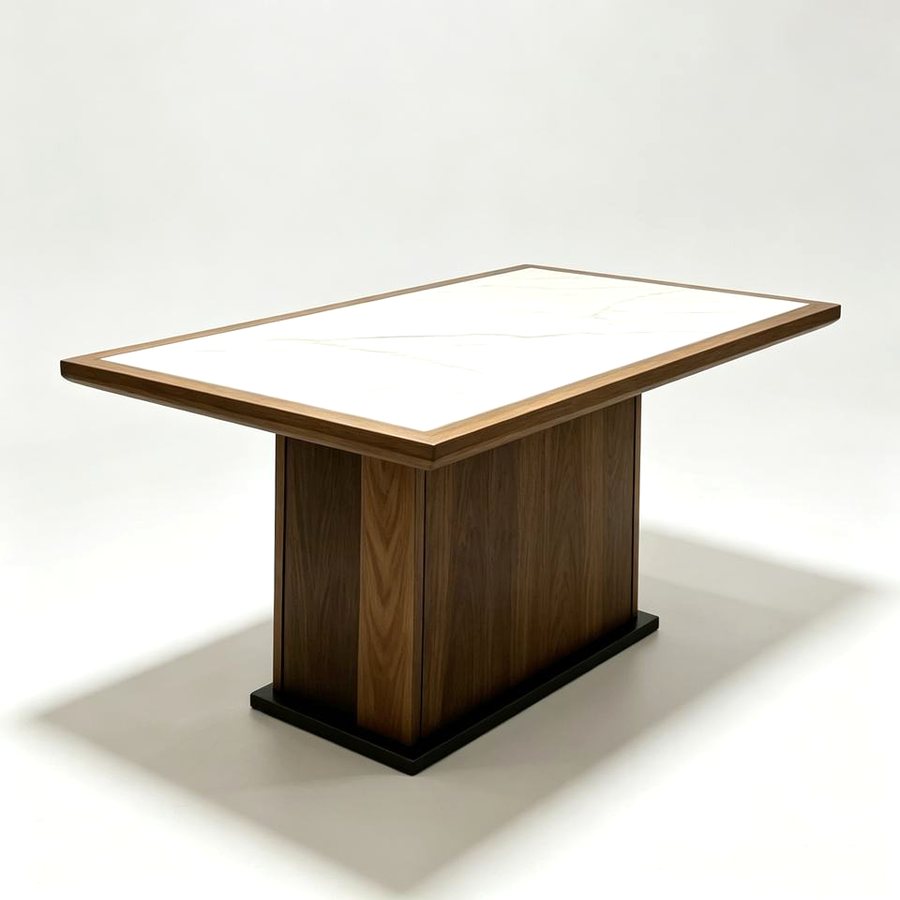
Rectangular pedestal table
Rectangular tops are the only ones that follow a wall exactly, and the pedestal is what makes that possible without four legs landing in the seating.
| Top | Rectangular, made to length |
|---|---|
| Top material | Wood |
| Frame | Steel plate |
| Size | Standard sizes or made to order |
| Seats | By length |
| Shape | Rectangular |
| Terms | EXW Foshan or DDP to your address |
Trade enquiries only · EXW Foshan or DDP · replies inside three working days
Length is the variable that matters
Window runs are 2140 mm, not 2100. Banquettes run 3200 mm back to back, not three tables of 1050. Cutting the top to the room removes the strip of dead floor that catalogue sizes leave at each end, and it is the difference between a run that looks built in and a line of tables pushed against a wall.
The pedestal is what makes the length workable. Under a 3000 mm top, two plate pedestals carry the span, and the floor between them stays clear for feet.
Plate pedestal, not a column
Round columns under a rectangular top look like a mistake from the side. Flat plates run parallel to the long edge, so the support disappears under the top when the room is seen at an angle — and it spreads the load over an area rather than a point.
Plate bases also take a floor fixing cleanly where a run has to be immovable, which matters along a window that people lean on.
Matching a room that is already built
Where the joinery is fixed, the table has to fit it: 30 mm clearance at the wall for the skirting, a notch for a radiator, an end that stops short of a door swing. All of that is a drawing rather than a catalogue number, which is what this model is for.
Send a floor plan, get a priced layout back
Tell us the counter length, the number of covers and the look you want. We come back with stool counts, heights, finishes and a written quotation — usually inside three working days.